Reading
Reading Curriculum Intent
At Dean Field, we place reading at the heart of our curriculum and recognise it as a vital life skill. From the moment children begin with us in Nursery, we are committed to nurturing confident, enthusiastic, and lifelong readers. We believe that reading is fundamental not only to academic success but also to pupils’ wider personal development, as it underpins progress across all areas of the curriculum and opens the door to new ideas, experiences, and opportunities.
Our approach ensures that pupils develop both the skills and confidence to engage with printed language critically and thoughtfully. Through carefully planned reading experiences, we aim to foster rich language development so that, by the end of their primary education, pupils leave us with a broad vocabulary, strong comprehension skills, and the cultural capital needed to support their future learning and aspirations.
We follow a highly structured and systematic phonics programme, Read Write Inc., which is introduced in Nursery and continues until pupils are secure and confident readers. Phonics teaching is carefully tailored to meet individual needs, with pupils grouped according to their current reading ability rather than chronological age. This approach ensures that each child is appropriately supported and challenged, allowing them to make strong progress while developing a positive and enjoyable relationship with reading.
Aims for pupils
We put reading at the heart of everything we do as we believe it is a crucial part of our pupils’ educations.
We aim to:
- Ensure that reading has a high profile in school and take every opportunity to celebrate success in reading.
- Develop positive attitudes towards reading to ensure reading is an enjoyable experience for all pupils.
- Ensure reading is placed at the centre of our curriculum planning and development.
- Provide our children with the opportunity to read and respond to a wide range of high-quality texts that have been carefully selected for each year group to increase their level of fluency and independence.
- Teach our children a range of reading strategies so they can tackle reading problems and apply them to the wider curriculum.
- Involve, engage and update parents on their child’s progress via home-school reading record communications and parent workshops.
- Upskill staff by providing them with training on a regular basis to ensure they are up to-date with school policies and procedures.
- Monitor and assess phonics every half-term to ensure children are placed in the right Read, Write, Inc. group to support their individual reading ability.
How our Reading Curriculum Is Constructed
At Dean Field, reading is placed at the forefront of our curriculum planning and design. Teachers plan weekly, high-quality reading viper lessons to explicitly teach children the key reading skills. We also take a text-based approach in English that provides teachers with opportunities to cover national curriculum objectives through the key texts. In addition to this, we also provide children with Accelerated reader books that they read at home and at school. Pupils also get the opportunity to apply their reading skills in other areas of the curriculum, like science, geography and history, and as a school we are very keen to provide these opportunities wherever possible. We also explicitly teach our pupils how to become fluent readers in KS1 and KS2 via weekly fluency lessons
Reading VIPERS
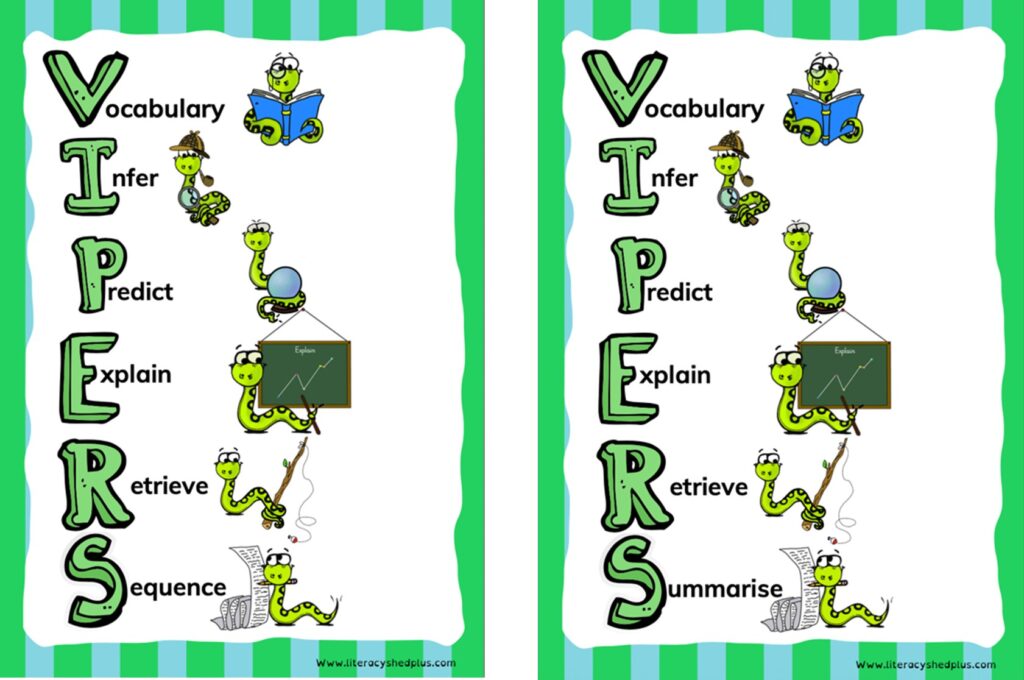
Reading VIPERS are used to explicitly teach the key reading skills to pupils in KS1 and KS2 to allow them to become successful readers. The key reading skills that are covered during these lessons are areas of reading that are assessed in the KS1 and KS2 assessments. They are: vocabulary, infer, predict, explain, retrieve and summarise. We use a wide range of high-quality texts, images and short films that have a suitable level of challenge for pupils.
Reading VIPER lessons consist of three vital parts: reading fluency, text marking and answering key questions about the text. Reading fluency is when children echo read the text with the teacher. By doing this they are learning how to read with the correct level of intonation and expression and they get the opportunity to listen to what fluent reading sounds like. After the reading fluency session, children then text mark the text to show the intonation. They use different symbols to show where they should pause, where they should raise their voice, where they should add expression and where they should add extra expression. Pupils then answer questions about the text that test their understanding of the key reading strands.
Accelerated Reader
In Key Stage 1 and Key Stage 2 children access the Accelerated Reader program (AR) which encourages substantial differentiated reading practice in order to create strong readers. Based on each student’s independent reading level, AR helps our teachers set personalised goals for each student and guide students to books difficult enough to keep them challenged, but not so difficult to cause frustration. First, a student’s optimal reading level is determined through the STAR Reading assessment. This assessment provides information on a student’s overall reading ability and suggests a range of book levels for each student called the “zone of proximal development”, or ZPD. By doing this, teachers are reassured that children are reading books at the correct level with a suitable amount of challenge which ultimately helps raise standards in reading. Pupils take the STAR Reading test at the end of every half term as a way of assessing reading and ensuring they are moving up ZPD ranges appropriately based on their reading age.
Individual Reading
At Dean Field, we aim to ensure that all pupils are heard reading at least once each week. In some cases, particularly to support our disadvantaged and most vulnerable pupils, children may read daily with a member of staff. Pupils read and discuss their Accelerated Reader (AR) book with their teacher or teaching assistant, and this is recorded in their home–school reading record. Entries include a positive comment to encourage motivation, alongside a clear and constructive next step. These next steps are precise, designed to address any gaps in reading or to support further progress, and are directly linked to National Curriculum objectives.
Pupils following the Read Write Inc. (RWI) programme take home a book that reflects the sounds they already know, as well as the book currently being studied within their RWI group that week.
Repeated Text Library
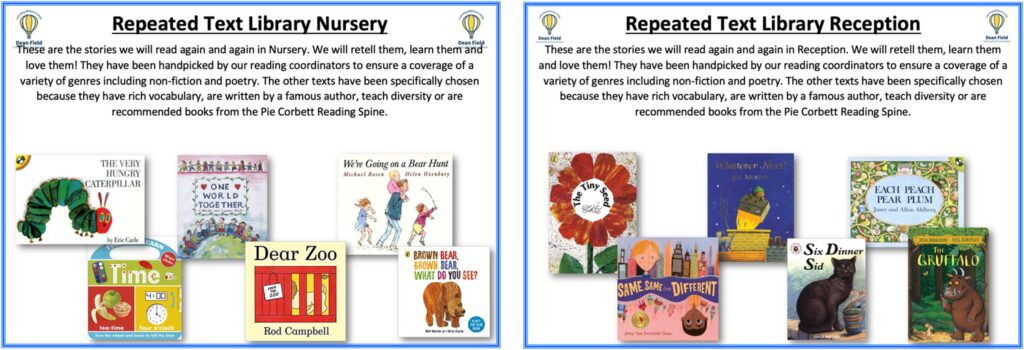
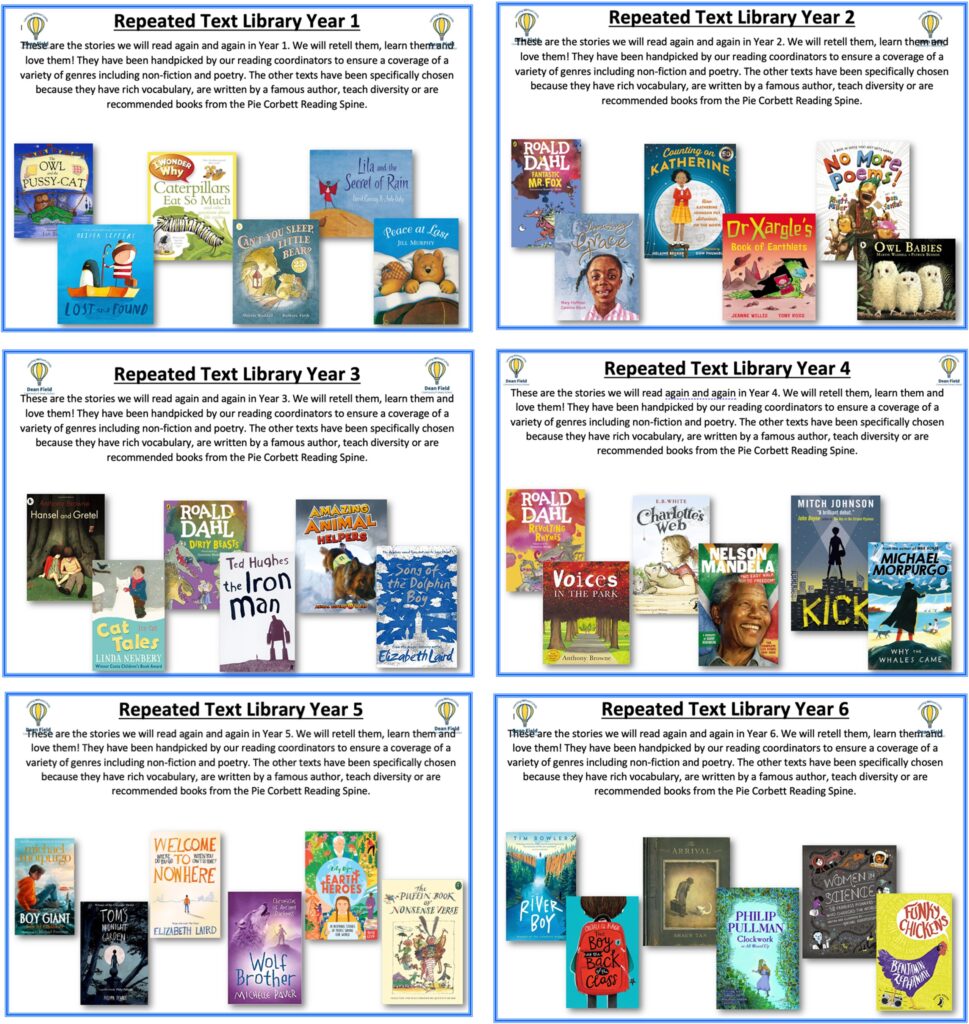
We have adopted a whole-school approach and made a clear commitment to developing pupils’ story language, vocabulary, and love of reading. Each class has a core set of texts that are revisited throughout the year to support vocabulary development and to help pupils deepen their understanding of story language and narrative techniques.
All texts have been carefully selected to ensure coverage of a wide range of genres, including poetry and non-fiction. Additional texts have been chosen for their rich vocabulary, authorship by well-known writers, promotion of diversity, or inclusion on the Pie Corbett reading spine. Through repeated exposure to these texts, we aim to embed key vocabulary and storytelling techniques so that, by the end of the year, pupils have developed a strong bank of ideas to support both their reading and writing.
Reading Fluency
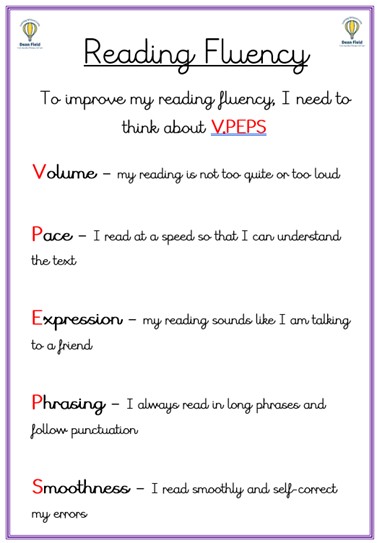
At Dean Field, we recognise that effective reading is underpinned by two key components: word reading and comprehension. In order for pupils to be successful readers, we believe it is essential that they develop strong reading fluency, which supports both accurate decoding and meaningful understanding of texts.
To support this, all pupils participate in weekly reading fluency lessons. These lessons focus on developing accuracy, automaticity, and prosody, enabling pupils to read words effortlessly while using appropriate expression, intonation, and phrasing. As pupils become more fluent readers, they are better able to direct their cognitive attention towards comprehension, vocabulary development, and inference.
Oracy is an integral part of our approach to reading fluency. Pupils are given regular opportunities to rehearse language aloud, discuss texts, and engage in repeated oral reading, which strengthens confidence, articulation, and expressive language. Through structured talk and performance-style reading, pupils learn how spoken language and written text are closely connected.
Our teaching staff have received high-quality professional development to ensure they can explicitly teach and effectively model fluent reading. Teachers demonstrate how skilled readers use pace, expression, and phrasing to bring texts to life, supporting pupils in understanding how prosody enhances meaning. Through consistent modelling, guided practice, and feedback, we aim to develop confident, fluent readers who can access and enjoy a wide range of texts.
Developing Tier Two Vocabulary
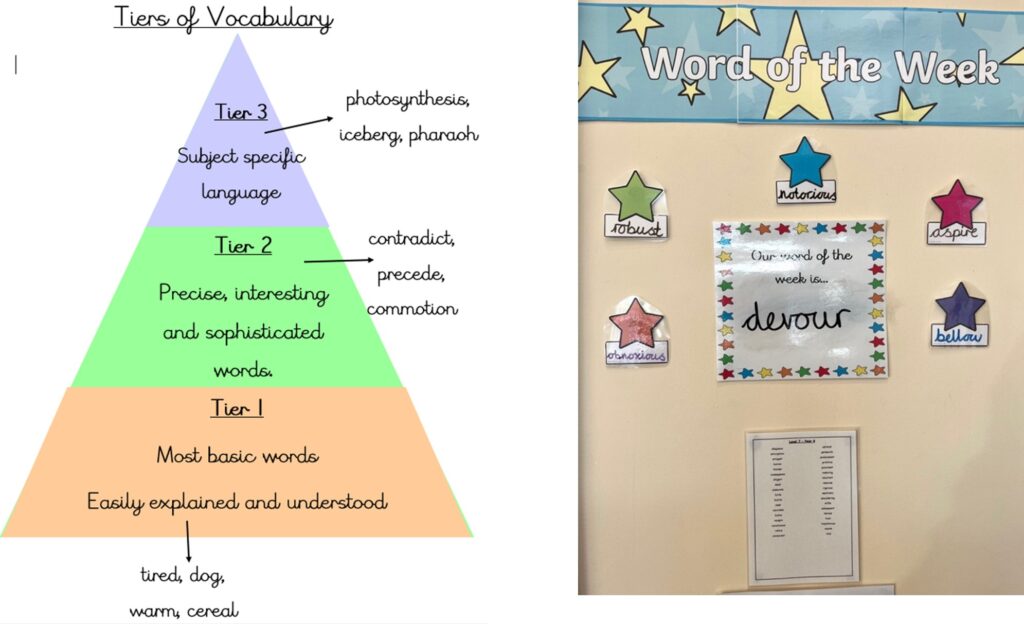
At Dean Field, we have adopted a whole-school Word of the Week approach to explicitly develop pupils’ Tier 2 vocabulary. We recognise that pupils naturally acquire Tier 1 vocabulary through everyday spoken language and are regularly exposed to Tier 3, subject-specific vocabulary through curriculum teaching. However, Tier 2 vocabulary appears less frequently in spoken language and, as a result, many pupils find these words more challenging to recognise, understand, and apply when encountered in a range of texts. This can impact reading fluency and slow reading pace, particularly when pupils meet unfamiliar vocabulary in context.
To address this, each year group introduces a carefully selected Tier 2 Word of the Week. This word is prominently displayed within the classroom environment and shared with parents to encourage reinforcement beyond school. Throughout the week, teaching staff explicitly model the correct use of the word in their spoken language and provide regular opportunities for pupils to rehearse and apply it across a range of contexts.
Teachers actively encourage pupils to use the focus word in discussion, reading, and writing and provide praise and rewards when pupils use Tier 2 vocabulary accurately and confidently. This consistent exposure and celebration of ambitious vocabulary supports pupils in deepening their understanding of language, improves automatic word recognition, and enhances both reading fluency and comprehension. Over time, this approach aims to build a rich and transferable vocabulary that pupils can draw upon across the curriculum.
Reading for Pleasure
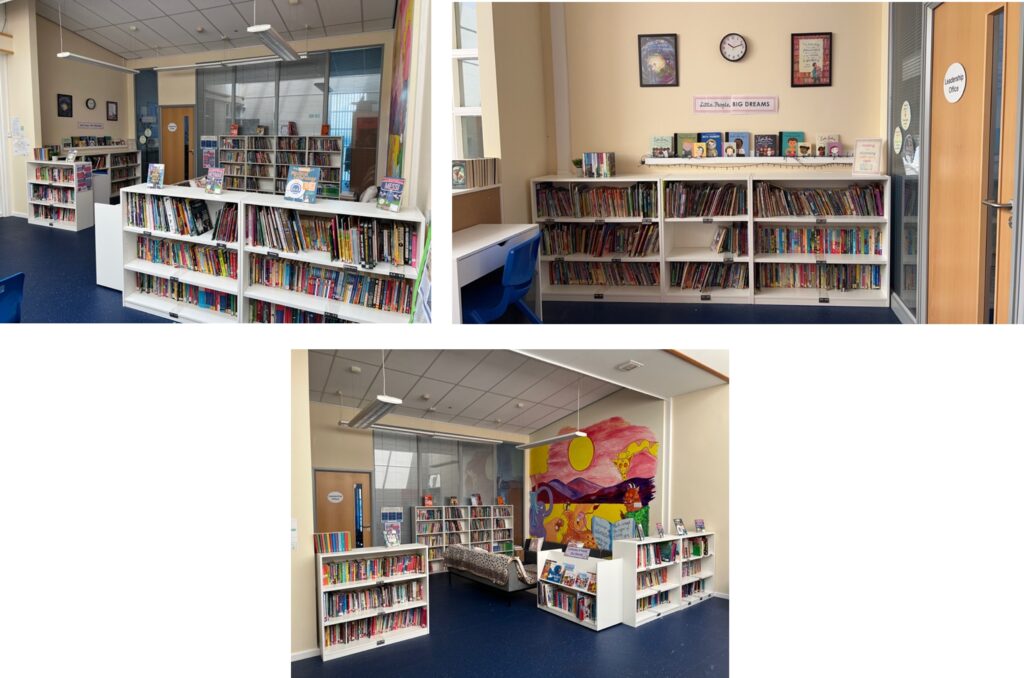
Reading for pleasure sits at the heart of everything we do at Dean Field, with the aim of fostering a genuine love of reading and encouraging pupils to explore a wide range of genres. Our vibrant and welcoming school library is designed to engage all readers, including those who may be more reluctant, and offers a broad selection of texts to suit different interests and reading abilities. The library is carefully resourced in response to pupils’ interests, ensuring that there are appropriate and engaging texts available for all readers.
Pupils are encouraged to read a weekly newspaper during reading sessions or to take it home to share with their families, allowing them to engage with current affairs. This supports the development of non-fiction reading skills while also contributing to pupils’ cultural capital.
We also run a highly successful Borrow a Bedtime Story scheme, which enables pupils to take home texts of their choice. This provides opportunities for children to access and enjoy books beyond their Accelerated Reader level or, for pupils in EYFS, beyond their current phonics stage. The scheme promotes shared reading at home and ensures that all pupils are able to experience and develop a love of books.
Reading for pleasure is further promoted through our weekly Accelerated Reader award. Each Friday, during our Gold Book celebration assembly, pupils in Years 1 to 6 discover which class has achieved the highest average quiz score on their Accelerated Reader books. This friendly competition motivates pupils to read more widely and engage thoughtfully with their reading. The class with the highest average score is awarded a trophy to display in their classroom.
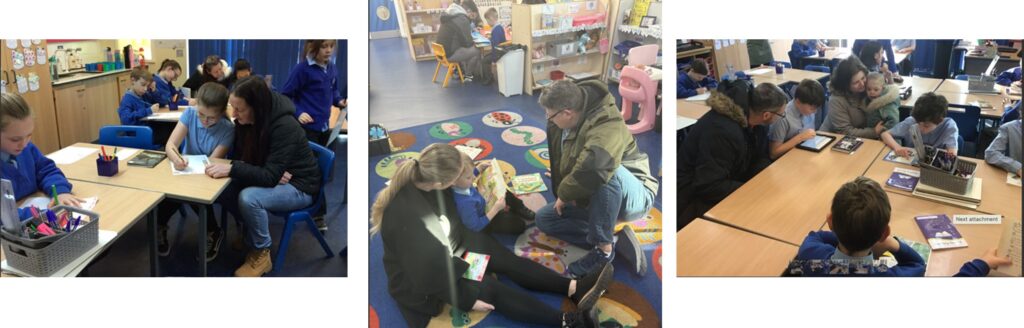
Every half term, we invite parents into school to share and celebrate a love of reading with their children. These sessions provide pupils with the opportunity to read aloud to their adults, share stories, and talk confidently about their reading preferences and progress. Through discussion and shared reading, pupils are encouraged to reflect on their development as readers and to take pride in their achievements.
Parents are also given the opportunity to visit the school library alongside their child, where they can explore a range of texts and support their child in selecting and changing books. These events strengthen the partnership between home and school, promote positive reading habits, and reinforce the importance of reading for pleasure both in and beyond the classroom.