Science Curriculum Intent
At Dean Field Community Primary School, we believe it is important for our pupils to have a strong understanding of the world around them through stimulating and engaging lessons. Our young scientists will acquire life-long enquiry science skills, in order to explore and understand the world they live in, alongside the vast knowledge of the disciplines of biology, physics and chemistry. They will also develop an understanding of the vital role that major scientific ideas and scientists have played in society. In doing so, all our children, regardless of their starting points, will be fully prepared for their next stage of science education, and beyond.
Science at Dean Field is taught discretely, with a focus on substantive knowledge-rich content and the development of essential disciplinary knowledge. The curriculum is full adhered to the National Curriculum programmes of study and Early Years Foundation Stage framework with the focus of a knowledge-rich content. Science is taught throughout both key stages with some topics being revisited in later year groups to enhance their understanding. Within these topics, scientific enquiry skills are embedded to help children retain the information, increase their understanding and build on their prior knowledge they already have. Children are encouraged to become independent learners through the use of skills such as, observing, investigating and questioning when exploring scientific based problems.
We believe it is important for our pupils to have a strong understanding of the world around them through stimulating and engaging lessons. We encourage the children to work scientifically whilst using a range of specific skills to deepen their understanding of the science curriculum. Our curriculum encourages children to be curious about the natural phenomena and to be excited by the process of understanding the world around them.
As a school, we provide the children with a scientific vocabulary sheet at the beginning of each topic to introduce them to the key vocabulary they will need to understand. We also plan engaging lessons, trips and visits to encourage challenge and progression for the children. Our science curriculum is planned to ensure the children have a love for science whilst making good or better progress. This is monitored through half termly assessments, target tracker, science days and pupil interviews, which reflects our aim to achieve well in science.
Aims for pupils
EYFS
- Begin to develop the children’s knowledge and skills that they will build on throughout their school years, such as developing their skills of observation, exploring, prediction, critical thinking and discussion about the world around them.
- ask questions about why things happen and how things work.
- Children to explore and respond to a variety of sensory experiences by collecting a variety of materials.
Key Stage 1:
- Build on their prior knowledge to develop their experience and understanding of themselves and their environment.
- Encouraged to be curious and ask questions about what they notice.
- Helped to develop their understanding of scientific ideas by using different types of scientific enquiry to answer their own questions, including observing changes over a period of time, noticing patterns, grouping and classifying things, carrying out simple comparative tests, and finding things out using secondary sources of information.
- Begin to use simple scientific language to talk about what they have found out and communicate their ideas to a range of audiences in a variety of ways.
Lower Key Stage 2:
- Build on their prior knowledge to broaden their scientific view of the world around them. They should do this through exploring, talking about, testing and developing ideas about everyday phenomena and the relationships between living things and familiar environments, and by beginning to develop their ideas about functions, relationships and interactions.
- Ask their own questions about what they observe and make some decisions about which types of scientific enquiry are likely to be the best ways of answering them, including observing changes over time, noticing patterns, grouping and classifying things, carrying out simple comparative and fair tests and finding things out using secondary sources of information.
- Draw simple conclusions and use some scientific language, first, to talk about and, later, to write about what they have found out.
Upper Key Stage 2:
- Build on their prior knowledge to develop a deeper understanding of a wide range of scientific ideas.
- Encounter more abstract ideas and begin to recognise how these ideas help them to understand and predict how the world operates.
- Recognise that scientific ideas change and develop over time.
- Select the most appropriate ways to answer science questions using different types of scientific enquiry, including observing changes over different periods of time, noticing patterns, grouping and classifying things, carrying out comparative and fair tests and finding things out using a wide range of secondary sources of information. Pupils should draw conclusions based on their data and observations, use evidence to justify their ideas, and use their scientific knowledge and understanding to explain their findings.
How our science Curriculum Is Constructed
At Dean Field teachers plan lessons around the National Curriculum objectives to build-up skills in each year group by building on previous learning. If all content is taught appropriately for each year groups, the children will build on this as they move through school.
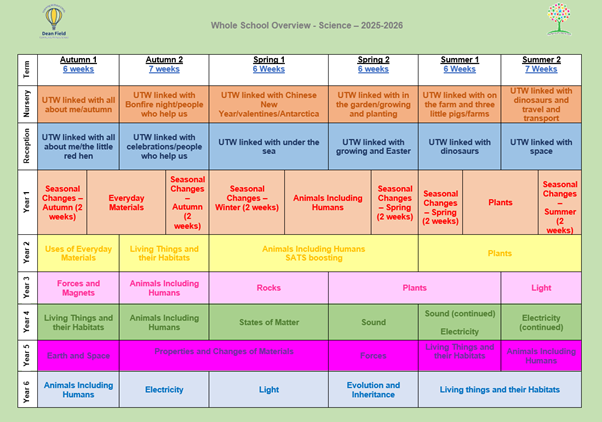
The subject leader provides a long-term plan overview of the topics that should be taught and when. These topics are selected to match other curriculum areas to encourage cross-curricular links where possible so these skills can be applied to other areas of the curriculum.
To support our science teaching in school, teachers produce ‘Must Knows’ to help children understand key facts and vocabulary linked to their science topic. Each teacher plans a vocabulary lesson at the beginning of the topic to expose the children to vocabulary linked to the topic so they are familiar with the terms and to reduce barriers within lessons. Where appropriate, children will have their own ‘My Must Knows’ to ensure they have retained knowledge and skills at a secure level before moving on too quickly and having gaps in their learning.
Science lessons are planned using a skill-based approach to ensure that the children are acquiring new skills whilst working scientifically throughout every science topic. Teachers liaise with other teachers and colleagues to ensure prior knowledge is drawn upon and used as a foundation for future learning.
With thoughtful planning, teachers integrate science and English to enhance the learning in both areas e.g. writing at length by writing scientific investigations. We activate student’s prior knowledge to develop new or more complex skills and acquire knowledge of a new subject.
Teacher’s link the teaching of mathematical skills in science e.g. using their recording skills to present scientific enquiry through the use of reading, writing and interpreting graphs.
Children have access to iPads within the classroom to integrate computing in to their lessons to enhance scientific learning and enquiry.
Children begin all science books with a presentation policy to encourage the consistency of presentation and handwriting linked to their English curriculum.
All our curriculum topics are carefully planned to encourage cross-curricular links within science in all year groups
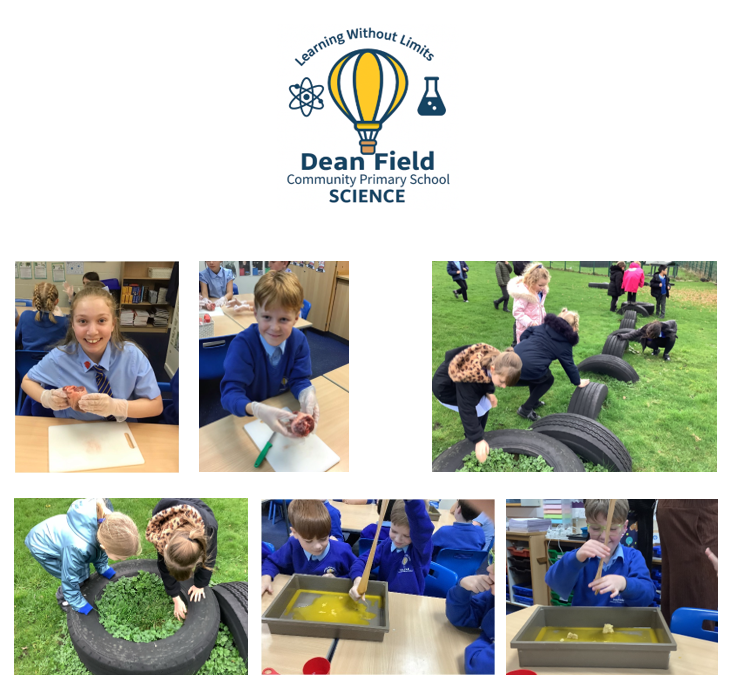
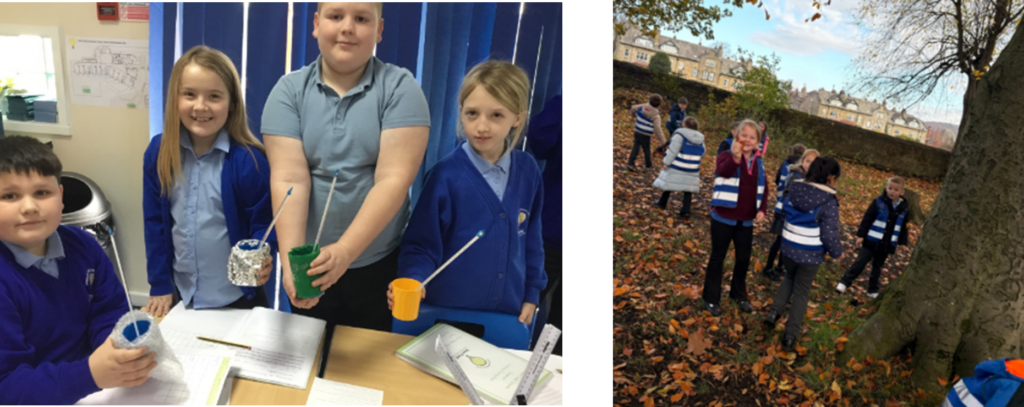
We plan various experiences to develop their skills in the curriculum area to prepare them for the real world. We also take advantage of any opportunities to visit our local community or wider community to see what is happening around us.
Staff meetings and informal professional discussions across the trust are used to develop the science curriculum and to ensure consistency of knowledge, skills, approach, and of standards.
In the EYFS, science long term plans start in Nursery and sequence specific knowledge and skills embedded into engaging topics to benefit the children’s knowledge and understanding in science and prepare them for a deep understanding further up school. The long term plans then continue right up until year 6.
In the EYFS, scientific aspects of the children’s work are related to the objectives set out in the Early Learning Goals (ELGs), as outlined in Development Matters. By providing learning opportunities throughout the EYFS academic years children will develop the skills in the above areas to make them ‘curriculum ready’ for science when they enter Year One. In EYFS teachers ensure they plan to specifically support the area ‘Understanding the World’ as this has the greatest link to the subject science.
In EYFS, each half-term is planned after analysing the Gap Strength Analysis from the term before to see what gaps need plugging to ensure every child makes sufficient progress. Experience based play is then planned to support children meeting these statements before they leave the EYFS, ensuring they have the foundation skills to progress through the subject in Years 1-6.
Long Term Planning
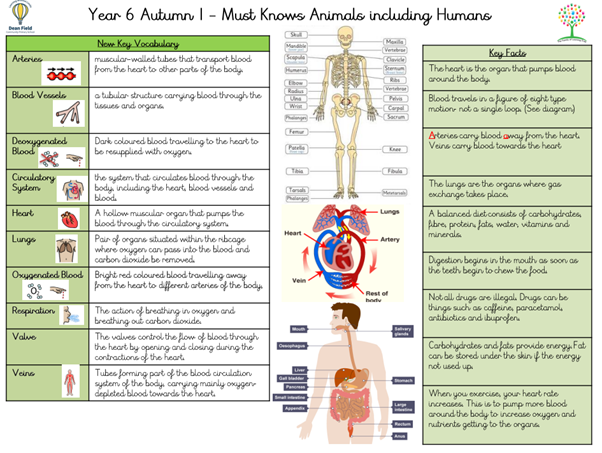
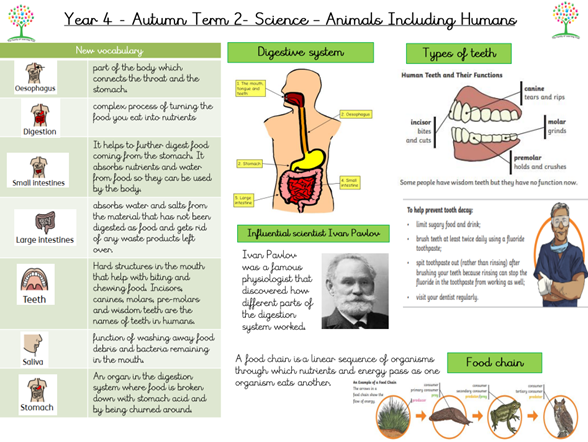
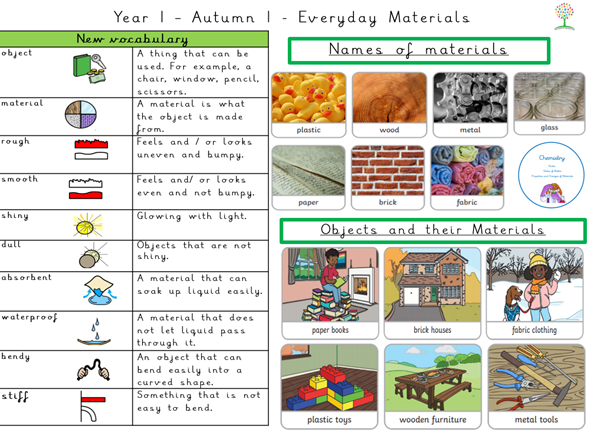
Science Must Knows
Below, are a selection of the Must Knows that we provide for each year group, for each Science topic covered. These Must Knows are designed to be used at home by parents as part of homework and revision, in school to supplement work in lessons and to recap previous learning. We want every pupil to be able to recall the facts given on the sheet but also to research further into the information provided. These are carefully structured so that knowledge and vocabulary are sequenced and built upon over time. We are confident that these Must Knows will help our children to develop and retain key knowledge on a wide range of topics and will significantly improve their vocabulary.
A full range of science Must Knows can be found on each class’ Seesaw account.
North Halifax Grammar School
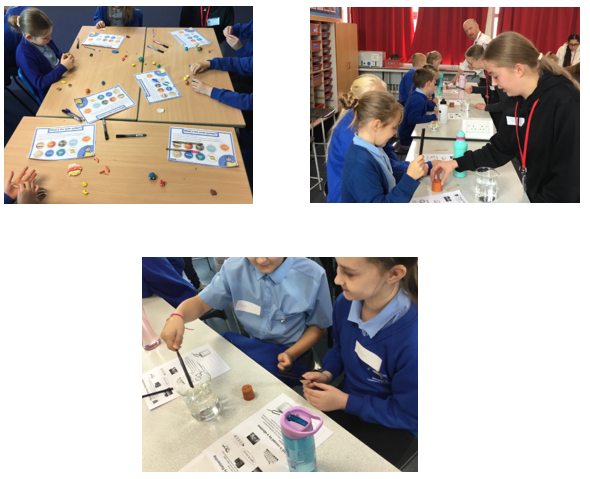
Sixth form students from North Halifax Grammar School hosted Year 5 pupils for a science masterclass, providing an introduction to secondary school science teaching. Subsequently, two sixth form students visited Dean Field to deliver a six-week programme focused on a science topic of their choice. Pupils in Years 5 and 6 participated in these sessions to enhance their understanding of science.