Writing Curriculum Intent
At Dean Field we believe that writing is a fundamental life skill and a powerful means of communication, self-expression and learning. Our writing curriculum is designed to enable all pupils to become confident, articulate and creative writers who can communicate their ideas clearly and effectively for a range of purposes and audiences.
We intend for pupils to develop a secure understanding of the transcriptional skills of spelling, handwriting and grammar, alongside the compositional skills needed to plan, draft, edit and evaluate their writing. Through a carefully sequenced curriculum, pupils build knowledge and skills progressively, allowing them to write with increasing accuracy, fluency and sophistication as they move through the school.
Our curriculum exposes pupils to a wide range of high-quality texts and rich vocabulary, which inspire writing across a variety of genres and contexts, including fiction, non-fiction and poetry. Writing is meaningfully embedded across the wider curriculum so that pupils understand its relevance beyond the English lesson and can apply their skills in different subjects and real-life situations.
We are committed to ensuring that all pupils, including those with SEND and those who are disadvantaged, can succeed as writers. Teaching is inclusive and ambitious, with appropriate scaffolding, challenge and opportunities for support where needed. By the time pupils leave our school, we aim for them to be resilient, reflective writers who take pride in their work and are well prepared for the next stage of their education.
Aims for pupils
- Communicate effectively for a variety of purposes, demonstrating the ability to listen attentively and respond appropriately, showing a clear understanding of spoken language in different contexts.
- Read and write with confidence, fluency, and comprehension, developing a deep understanding of the texts they encounter and the ability to express their ideas clearly and coherently in writing.
- Apply a range of spelling strategies accurately and consistently, using them independently to support the development of their written work across all subjects.
- Engage with and experience a broad spectrum of text types and genres, enabling them to understand different writing conventions and to write creatively and purposefully for a variety of audiences.
- Develop imagination, inventiveness, and critical thinking through the exploration of language, enabling them to express ideas creatively and reflect thoughtfully on their own and others’ writing.
- Foster a love of language and a genuine enjoyment of writing, giving pupils the confidence to use language creatively and appropriately in a wide range of contexts.
- Encourage pupils to become articulate speakers and attentive, responsive listeners, capable of participating in discussions, presentations, and collaborative learning experiences with clarity and confidence.
- Develop a fluent, legible, and personal handwriting style, and cultivate a high standard of presentation in all written work, demonstrating pride and care in their learning.
How our Writing Curriculum Is Constructed
At Dean Field, our writing curriculum is carefully designed to ensure continuity, progression, and engagement from the Early Years Foundation Stage (EYFS) through to Key Stage Two (KS2). In the Early Years, we follow the EYFS framework, ensuring that children develop a solid foundation in early literacy skills. This approach allows for a smooth transition into the National Curriculum, providing a consistent and progressive pathway for reading, writing, and language development.
In Key Stage One and Two, we adopt a creative and flexible approach to planning Literacy lessons. Our planning is informed by the objectives outlined in the National Curriculum 2014, ensuring that lessons are purposeful, structured, and ambitious. At the same time, lessons are designed to be imaginative, engaging, and tailored to the needs of the children at Dean Field. Writing opportunities are often linked to the class topic and may be cross-curricular when appropriate, allowing pupils to see the relevance of writing across subjects and in real-life contexts.
Teaching and Learning
English is taught daily across Years 1–6, with the Foundation Stage integrating English within topic sessions and often through short focused morning activities. In addition to daily Literacy lessons, all children in Year 1 participate in Read Write Inc (RWI) lessons for approximately 40 minutes each day, ensuring targeted support that meets their reading ability. In Year 2 and KS2, children receive a daily Spelling, Punctuation, and Grammar (SPAG) lesson, where spelling, grammar, and handwriting skills are explicitly taught.
Interventions are available for children in Year 2 and KS2 who require additional support with phonics, including RWI sessions, to ensure that all pupils are able to access the curriculum successfully. At least once a week, classes participate in a focused reading comprehension session, led by the class teacher or teaching assistant. These sessions are designed to develop higher-order thinking skills, deepen understanding of texts, and broaden vocabulary knowledge.
Through this structured yet flexible approach, our writing curriculum ensures that pupils develop the skills, knowledge, and confidence to become fluent, imaginative, and reflective writers, fully prepared for the next stage of their learning.
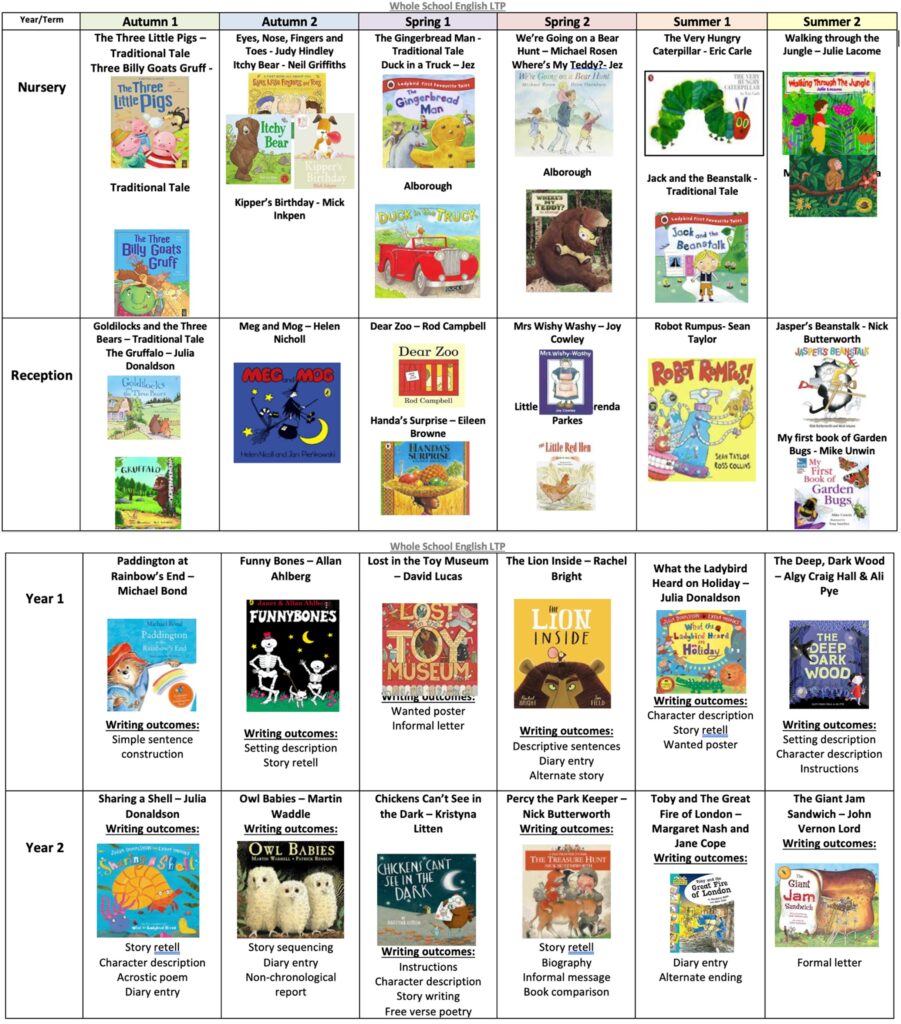
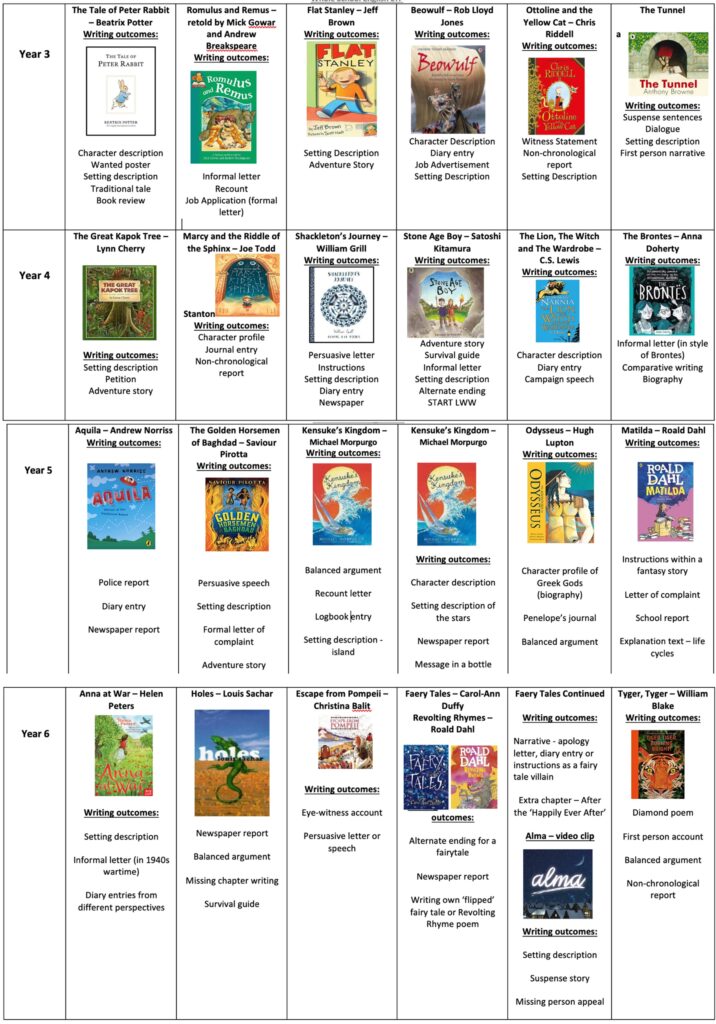
Long Term Plans
Modelled Writing
At Dean Field, teachers consistently model the writing process during English lessons to provide pupils with a clear demonstration of how effective writing is constructed. Both teachers and teaching assistants explicitly model the development of sentences, the accurate and purposeful use of spelling, punctuation, and grammar (SPAG), and the application of imaginative thinking to writing tasks. They also demonstrate how to write for a range of audiences and purposes, using the school’s cursive handwriting script, thereby providing pupils with high-quality examples of writing to emulate.
This deliberate and visible modelling supports pupils in internalising the techniques, structures, and conventions of successful writing. By observing skilled practitioners in action, children develop a stronger understanding of how to plan, draft, and refine their own work. This approach not only raises the standard of writing across the school but also fosters pupils’ confidence and ambition. It encourages all children to take pride in their work, strive for excellence, and develop the skills and resilience necessary to become independent and proficient writers.
Spellings
At Dean Field, pupils are explicitly taught the rules and conventions of spelling through a dedicated weekly spelling lesson. Teachers ensure that spelling instruction is carefully matched to pupils’ individual abilities, using resources such as Spelling Shed to provide differentiated word lists and targeted practice. Pupils are provided with their weekly spellings on a Friday to practise at home, while also receiving at least half an hour of focused spelling practice during the school week. This structured approach allows children to consolidate their understanding of spelling patterns, develop accuracy, and apply their knowledge independently in written work. Progress is closely monitored through weekly spelling tests, and outcomes are regularly shared with parents via Seesaw, fostering home-school engagement in supporting children’s literacy development.
Learning to spell accurately is a fundamental component of becoming a confident and competent writer. Mastery of spelling supports reading fluency, writing clarity, and the ability to communicate effectively for a range of purposes and audiences. By understanding the rules and patterns that underpin the English language, pupils gain the skills necessary to write with precision, build vocabulary, and take pride in the presentation of their work.
In addition to spelling, phonics is a key focus in the early stages of literacy development. In Year 1, pupils begin preparation for the statutory Phonics Screening Check early in the academic year, with daily assessments of their knowledge of letter sounds conducted through the Read Write Inc (RWI) programme. Pupils practise applying their phonics knowledge in a variety of contexts, including pseudo-word reading and practice assessments, to build confidence and familiarity with the test format. Teachers in Years 1 and 2 meet termly to review pupils’ progress, ensuring that interventions and targeted support are implemented for those who may need additional reinforcement.
Provision is carefully extended for pupils in Year 2 and beyond who did not take or did not pass the phonics check in Year 1. Targeted support continues into Year 3 for children requiring further assistance, ensuring that all pupils achieve a secure foundation in phonics, which is critical for reading, spelling, and overall literacy development. This systematic approach to phonics and spelling underpins the broader writing curriculum and supports pupils in becoming confident, accurate, and independent writers.
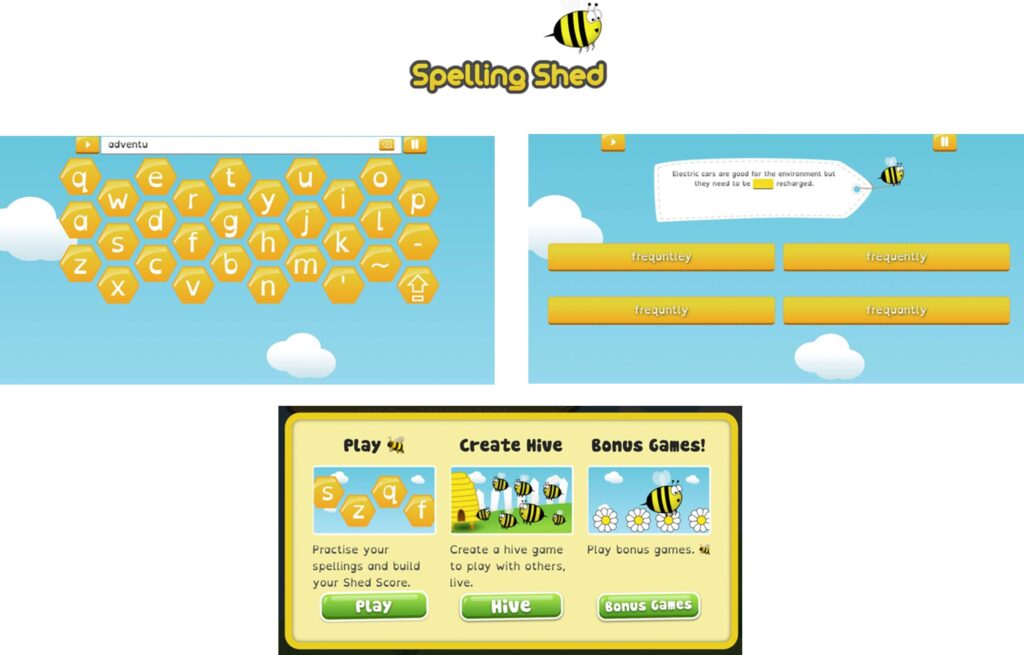
Here is our Spelling Shed parent’s guide
Handwriting
At Dean Field Primary School, we believe that clear, fluent handwriting is a fundamental life skill and an essential tool for learning, communication and self-expression. Our handwriting policy aims to ensure that all pupils develop the physical strength, fine motor control and correct letter formation needed to write confidently, legibly and with increasing fluency.
We recognise that handwriting development begins long before children formally write letters and therefore place strong emphasis on early gross and fine motor development in EYFS. As pupils progress through the school, handwriting is taught explicitly, systematically and progressively using Read Write Inc. (RWI) Letter Village to ensure consistency and continuity
Our intent is that:
- All children learn correct letter formation from the outset
- Poor habits are prevented through early intervention
- Handwriting teaching is inclusive, well-paced and responsive to individual needs
- Children develop pride in their written work and confidence as writers
Implementation
Handwriting is taught daily across the school in short, focused sessions appropriate to the age and stage of the child. Teaching follows a clear progression through stages, supported by consistent resources, assessment and intervention.
Nursery
- Focus on developing gross and fine motor skills essential for writing
- Activities include:
- Dough disco, threading, cutting, tweezers
- Large-scale mark making
- Core strength and shoulder stability activities
- No formal letter formation teaching
Stage One – Reception
- Letter formation taught following Stage 1 of RWI Letter Village
- Letters taught in phonics order:
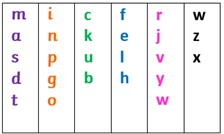
- 4 x 3-minute sessions per week focusing on one letter
- Teaching is:
- Teacher-led
- Explicit
- Delivered in groups of no more than 3 children
- Supported by RWI mnemonics
- Yellow pen used for immediate feedback and intervention
- Children complete 1 line per day using jam sponge paper
- Evidence recorded in a separate handwriting book
- Class and individual trackers updated weekly (evidence found in writing books)
- Children requiring further support receive:
- Short, regular interventions within provision
- Additional evidence sheets highlighted in books
- All staff use trackers to identify and support children needing intervention
Stage Two – Year 1
- Autumn 1 focuses on:
- Catching up letter formation where needed
- Embedding writing routines (e.g. sitting at tables, posture, pencil grip)
- Class tracker that has been handed up from Reception is used to inform planning
- All children have a separate handwriting book with jam sponge lines
- Letters taught as a whole class in grouped formations:
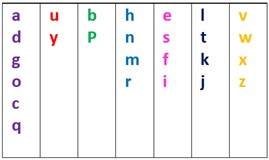
- 4 x 10-minute sessions per week
- Use Stage 2 RWI Letter Village videos for children who can already form letters correctly
- TA supports children still at the formation stage
- Focus children positioned near the teacher
- Teachers monitor practice closely to prevent incorrect formation becoming embedded
- Trackers updated weekly (evidence in English books)
- Short, regular keep-up interventions for identified pupils (groups of no more than 3)
Stage Three – Year 2
- Autumn 1 assessment using previous teacher’s tracker
- Children grouped according to need:
- Some move on to Stage 3 RWI Letter Village
- Others continue practising Stage 2 letter formation
- 4 x 10-minute sessions per week
- Small group support from teacher or TA during whole class sessions
- Separate handwriting books with jam sponge lines
- Close monitoring during practice to prevent incorrect formation
- Weekly tracker updates (evidence in writing books)
- Short, regular interventions delivered as needed
Key Stage 2
In Years 5 and 6, teachers continually monitor pupils’ handwriting and identify any gaps or inconsistencies in letter formation, spacing, alignment or fluency. Where gaps are identified, targeted support is provided through the RWI Letter Village programme to ensure pupils develop the skills needed to write clearly and confidently. Interventions are short, focused and delivered regularly to reinforce correct formation and prevent poor habits from re-emerging. These sessions are planned based on each pupil’s individual needs and may be delivered by the class teacher or a trained adult, either during dedicated handwriting time or through short catch-up sessions within English lessons. The aim is to ensure that all pupils leave Key Stage 2 with fluent, legible handwriting that supports their overall written communication and enables them to access the wider curriculum successfully.
Teaching and Learning
Handwriting at Dean Field is taught through explicit, high-quality modelling of correct letter formation, where adults demonstrate the formation process step-by-step and use consistent language to support pupil understanding. Teachers use the Read Write Inc. (RWI) mnemonics and formation cues consistently to reinforce correct letter shapes and encourage automaticity. Clear expectations for posture, pencil grip, paper position and letter orientation are established and reinforced so that children develop strong writing habits from the outset. Handwriting practice is delivered through short, focused sessions that occur frequently, allowing children to build muscle memory without fatigue. During these sessions, adults provide immediate feedback and in-the-moment intervention, correcting errors as they occur and supporting pupils to adjust their technique quickly.
Teachers and support staff ensure that incorrect letter formation is addressed swiftly to prevent poor habits from becoming entrenched. Handwriting is taught according to the child’s stage of development rather than their age, meaning that children receive the level of support they need to progress confidently and securely. Adults carefully monitor practice to ensure children do not repeat incorrect formations, intervening as soon as errors emerge and providing guided support until the correct formation is mastered. Learning is adapted to meet individual needs, with targeted support and additional practice for those who require it, while more confident writers are challenged to develop speed and fluency. As children progress, handwriting stamina is built gradually and appropriately, ensuring that pupils can maintain legibility and control across longer pieces of writing without compromising quality.
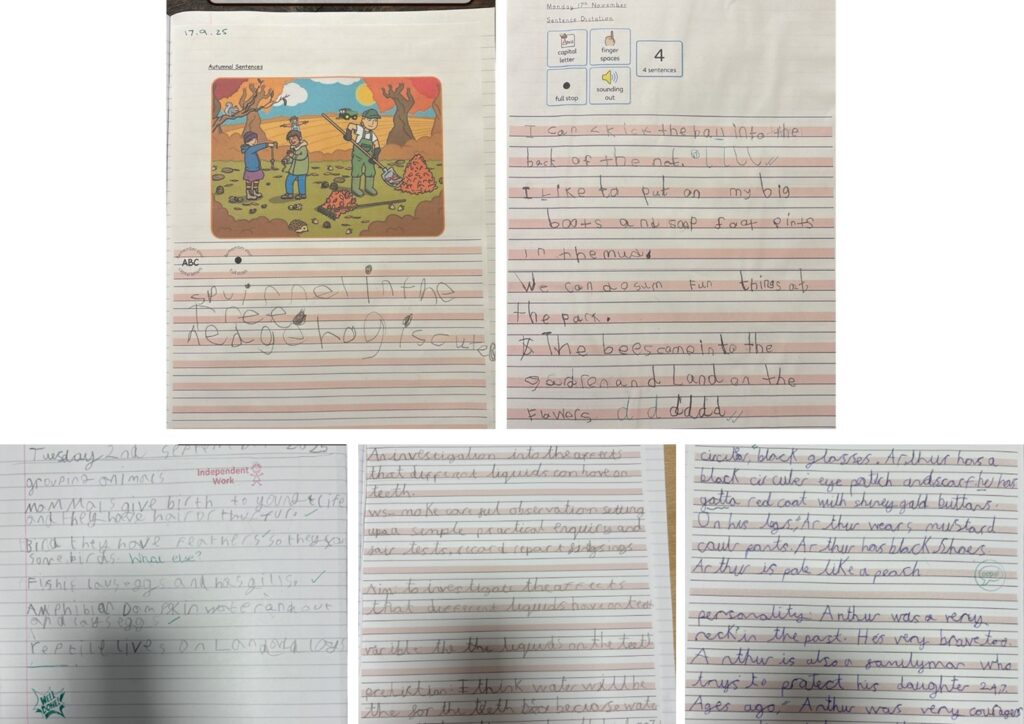
Impact of handwriting teaching
SPaG
At Dean Field, Spelling, Punctuation, and Grammar (SPAG) is taught through explicit, structured weekly lessons, in which pupils are introduced to and consolidate the objectives outlined in the National Curriculum. These lessons provide clear explanations, guided practice, and opportunities for pupils to apply their SPAG knowledge directly in their own writing. To support learning and retention, pupils make use of SPAG knowledge organisers (“Must Knows”), which provide a clear reference for key concepts in spelling, punctuation, and grammar.
Pupils’ progress is carefully monitored through a weekly SPAG assessment, enabling teachers to identify gaps in knowledge and understanding. This information is used to inform future planning, ensuring that lessons are responsive to the needs of all pupils. Teaching is adapted to provide additional support or challenge where required, so that pupils of varying abilities can access the curriculum effectively and achieve their full potential.
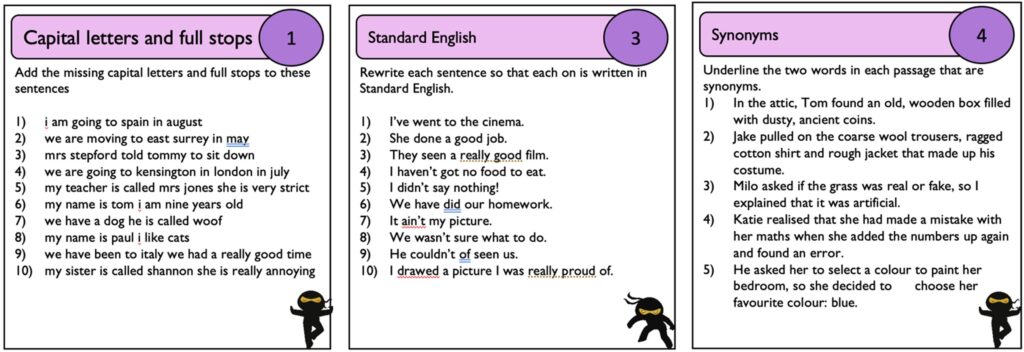
In addition to weekly lessons, SPAG learning is recapped and reinforced daily through starter activities in English lessons. These activities, often using resources such as Vocabulary Ninja, ensure that key concepts are revisited regularly, helping pupils to consolidate their understanding and apply their learning with confidence. By embedding SPAG practice throughout the week, pupils develop a secure grasp of grammatical rules, accurate punctuation, and correct spelling, all of which contribute to improving the clarity, accuracy, and sophistication of their written work.
This structured, responsive approach ensures that pupils not only acquire the technical skills necessary for writing but also gain the confidence to apply them independently across a range of genres and contexts.
Must Knows
Year 1
Year 2
Year 3
Year 4
Year 5
Vocabulary Ninja Starters