

Mathematics Intent
Our intention is for all children to enjoy mathematics and to develop a secure and deep understanding of fundamental mathematical concepts. We aim to equip children with a set of tools to help them understand and succeed in the world. These tools include problem solving skills, logical reasoning skills and the ability to think in abstract ways. Mathematics is important in everyday life. It is integral to all aspects of life and with this in mind we endeavour to ensure that children develop a positive and enthusiastic attitude towards mathematics that will stay with them.
The National Curriculum order for mathematics describes in detail what pupils must learn in each year group. This, combined with our calculation policy and our progression document ensures continuity as well as high expectations for attainment in mathematics.
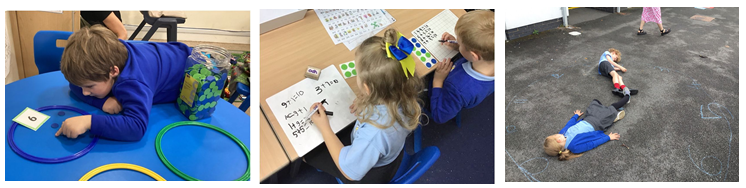
Aims for pupils
- To deliver quality first teaching to all pupils.
- To provide the resources needed to support progress.
- For pupils to become fluent in the fundamentals of mathematics.
- For pupils to develop a deep conceptual understanding in the fundamentals of mathematics.
- To develop pupils rapid recall of number facts.
- For pupils to explain their methods and reasoning mathematically and to justify their reasoning with the correct use of mathematical vocabulary.
- For pupils to make sense of number problems, including non-routine / ’real’ problems and identify the operations needed to solve them.
- For pupils to become confident, independent learners.
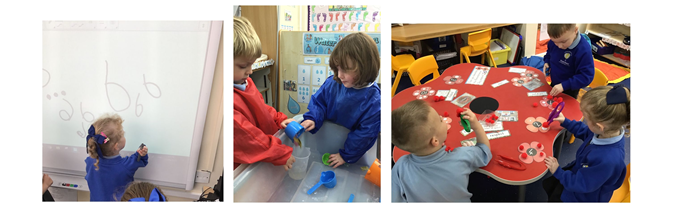
How our Mathematics Curriculum Is Constructed?
At Dean Field, mathematics is taught in the order of the National Curriculum strands to support coverage and ensure that learning is built on prior knowledge and skills. Teachers use the National Curriculum, White Rose Maths and our progression document when planning and breaking down objectives into small steps.
The subject leader provides a long-term overview of the objectives that should be taught. Although NC strands are taught in order in line with the White Rose maths steps, the time spent teaching each strand is flexible and based on the children’s level of understanding.
To support maths teaching in school, teachers produce ’must knows’ when planning to help children understand key principles and vocabulary. Vocabulary is progressive through school and teachers use the progression document when planning their unit of work. Must knows include new vocabulary and previously taught vocabulary to aid retention. Where appropriate, children will have their own ‘My Must Knows’ to ensure they have retained knowledge and skills at a secure level before moving on too quickly and having gaps in their learning.
Maths lessons are planned using a mastery style approach. Lessons progress through concrete, pictorial and abstract methods and all students are challenged with problem solving and reasoning tasks.
With thoughtful planning, teachers integrate maths across the curriculum wherever possible. For example, in science lessons, PE and even topic lessons. The children may be taught a new objective or work on consolidating existing learning.
In all classrooms, children have access to iPads to integrate computing in to their lessons. Tasks completed on the iPads are often planned in to maths lessons.
Developing a strong sense of number in the early years is essential so that all children develop the necessary building blocks to prepare them for the National Curriculum. Teachers carefully plan tasks which allow the children to build and apply their understanding of the numbers to 10, the relationship between them and the patterns within those numbers. They are exposed to and taught mathematical vocabulary from which the mastery of mathematics is built. Opportunities are provided for the children to develop their spatial reasoning skills across all areas of mathematics including shape, space and measures
Maths Policy
Long Term Planning
Mathematics Must Knows
Below, are a selection of the Must Knows that we provide for each year group, for each Mathematics topic covered. These Must Knows are designed to be used at home by parents as part of homework and revision, in school to supplement work in lessons and to recap previous learning. We want every pupil to be able to recall the facts given on the sheet but also to research further into the information provided. These are carefully structured so that knowledge and vocabulary are sequenced and built upon over time. We are confident that these Must Knows will help our children to develop and retain key knowledge on a wide range of areas and will significantly improve their vocabulary.
A full range of Mathematics Must Knows can be found on each class’ Seesaw account.
Year 2 – Measurement- Time
Year 2 – Number and Place Value
Year 4 – Money

From June 2020, year four children will complete a statutory times table check. This check is an online test in which pupils are asked to answer 25 questions on times tables from 2X to 12X. They are given 6 seconds per question, with 3 seconds rest between each question.
The websites below are a useful tool for children to practise as they mimic the actual test they will sit in June.
https://tt.serveweb.co.uk/quiz
https://www.timestables.co.uk/multiplication-tables-check/
https://mathsframe.co.uk/en/resources/resource/477/Multiplication-Tables-Check
Each child also has a Times Tables Rock Star account where they have personalised times tables assigned to them by their teacher
https://play.ttrockstars.com/auth/school/student/876
From Year 3 onwards, we use Number Sense every day to develop pupils’ times table knowledge. Daily sessions help children build fluency, accuracy, and confidence in recalling multiplication and division facts. The consistent approach enables pupils to strengthen their mathematical understanding, improve their speed of recall, and apply their times table knowledge more effectively across different areas of mathematics
Enriching Opportunities and Experiences
Maths is a topic that lends itself well to real life situations as we use maths all the time throughout our lives. We have had themed maths week to raise the profile of maths and to introduce them to mathematicians that have had an impact on our lives. We have school times tables trophies handed out weekly and also competitions within our trust. We take part in Number Day, which helps to raise money for the NSPCC as well as getting children involved in fun maths activities.
We look at real-life topics through our maths lessons, which enhances our children’s cultural capital such as: calculating with money, reading timetables, measuring and links with computing such as programming and pattern.
We took part in a cross-trust Times. Table Rock Star completion—Top of the Rocks—which we won!

We took part in a whole school maths money workshop as part of maths week with Own Futures.

We took part in a whole school ‘maths through stories’ as part of maths week
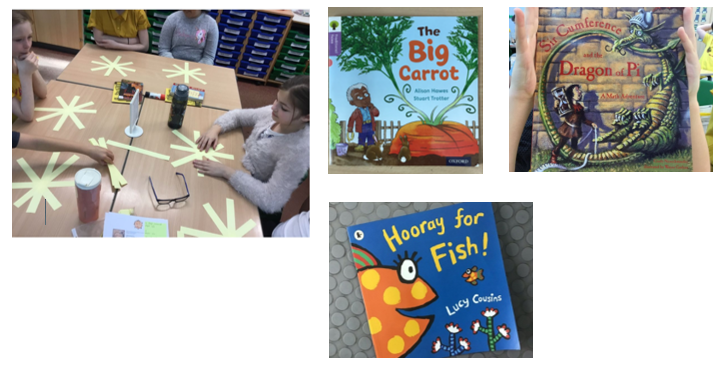
Times Fables
Same Day Intervention
Ten Town
Useful Websites
Multiplication Check
NumBots and Times Table Rock Stars
Calculation Methods