
Nursery Provision at Dean Field School
Our Dingley’s Promise Mark of Achievement Award reflects our commitment to creating a safe, inclusive and supportive environment where every child can thrive, build confidence and feel valued.
Please find our yearly and termly overviews here:
Yearly overview
Half termly overview
Admission to Nursery
An Exciting Start to “Learning Without Limits”
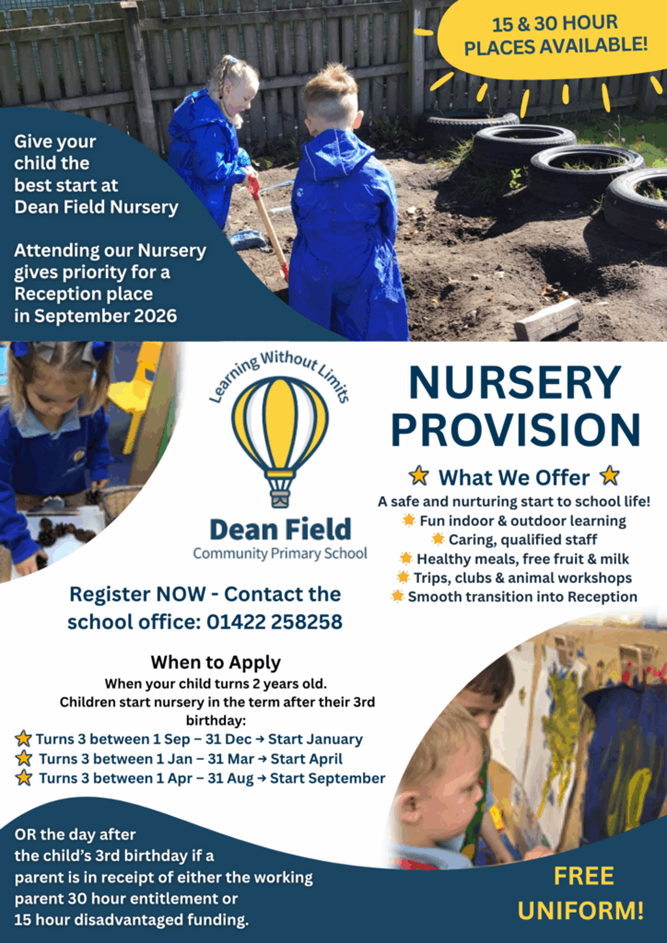
Dean Field Nursery provides a high-quality start to every child’s school journey, placing strong emphasis on developing confident, independent and resilient learners. Open 8:40am–2:50pm, Monday to Friday, our Nursery offers a nurturing, stimulating and inclusive environment where children feel safe, valued and ready to learn.
The majority of our Nursery children continue their learning journey into Reception making our Nursery the ideal preparation for the next stage and beyond. Children benefit from a smooth and carefully planned transition. This is because they are already familiar with key routines, expectations and whole-school life. This includes early phonics through Read Write Inc., using the dining hall, and taking part in shared school experiences all of which support confidence, consistency and a strong sense of belonging.
Our experienced team deliver an engaging curriculum aligned with the Early Years Foundation Stage (EYFS) ensuring children develop across all seven areas of learning. Learning is thoughtfully planned, sequenced and adapted to meet individual needs with staff using ongoing assessment to identify strengths and next steps. This ensures appropriate challenge and strong progress for all children.
A key focus in Nursery is the development of communication and language, independence and resilience which form the foundations for future learning in Reception and the wider curriculum. By the time children move on, they are confident, motivated and well prepared for the expectations of Reception and their continued learning journey through school.
The EYFS Framework
The EYFS Framework explains how and what your child will be learning to support their healthy development from birth to 5 years.
The full document can be found at:
https://www.gov.uk/government/publications/early-years-foundation-stage-framework–2
We use Development Matters to support our EYFS curriculum and teaching. It helps us understand how children typically develop and ensures learning is carefully planned to build strong foundations in communication, early reading, writing and maths preparing children for Year 1 and future learning.
The full document can be found at:
The 17 areas of learning and development:
Your child will be learning skills, acquiring new knowledge and demonstrating their understanding through 17 areas of learning and developing which come under the 7 different educational programmes as listed below:
Communication and Language
- Listening, Attention and Understanding
- Speaking
Personal, Social and Emotional Development
- Self-Regulation
- Managing Self
- Building Relationships
Physical Development
- Gross Motor Skills
- Fine Motor Skills
Literacy
- Comprehension
- Word Reading
- Writing
Mathematics
- Number
- Numerical Patterns
Understanding the World
- Past and Present
- People, Culture and Communities
- The Natural World
Expressive Arts and Design
- Creating with Materials
- Being Imaginative and Expressive
Characteristics of Effective Learning
- Playing and Exploring
- Active Learning
- Creative and Critical Thinking
At Dean Field, we place great importance on the Characteristics of Effective Learning which describe how children learn rather than what they learn. Children are encouraged to play and explore, be active learners, and think creatively and critically through carefully planned experiences and everyday interactions. Staff support children by modelling curiosity, encouraging perseverance, asking thoughtful questions and allowing time for children to practise and deepen their learning. By embedding these characteristics across Nursery and Reception, we help children develop confidence, independence, resilience and positive attitudes to learning that prepare them well for Key Stage 1 and beyond.
As a school, we contribute to the thematic approach to learning using a whole-school topic overview by selecting topics for each half-term for Nursery and Reception that we feel would encourage and excite children, these are reviewed but also not set in stone – meaning if children’s interests defer then we support this and change plans in order to maximize the most learning potential.
Assessment in Nursery
In Nursery, assessment is ongoing and forms an integral part of daily practice. Children’s learning and development are assessed primarily through play-based observations, meaningful interactions and any work they produce. These observations capture children’s interests, skills and progress and help staff to understand what each child knows and can do.
Observations are recorded on Seesaw allowing parents and carers to view, comment on and celebrate their child’s learning. We value the role of families as partners in learning and encourage parents and carers to share achievements, experiences and learning from home. These contributions help us build a full and holistic picture of each child recognising that children often demonstrate confidence and skills in different environments.
All observations are linked to the Early Years Foundation Stage (EYFS) Framework, enabling staff to identify children’s current attainment and plan clear, personalised next steps. Progress is reviewed at least half-termly using each child’s learning journey and evidence gathered through provision and adult-led activities.
Assessment information is recorded on Sonar Tracker, which is used consistently across the school. This ensures that as children move into Reception, staff have a secure and up-to-date understanding of each child’s strengths, progress and any areas requiring additional support. This continuity supports a smooth transition into Reception and enables learning to build effectively from children’s starting points.
Assessment in Nursery is used to inform planning, shape continuous provision and ensure appropriate challenge and support for all children. This careful approach ensures that children leave Nursery confident, motivated and well prepared for the next stage of their learning journey in Reception and beyond.
Support for Parents and Carers
We offer a wide range of support for parents including the helpful parent guide “What to Expect, When?” which can be found here:
We provide Yearly and termly EYFS information leaflets which can be found at the top of this page and easy communication with staff through Seesaw. Parents can upload observations from home which we use to support each child’s EYFS journey.
We value parental engagement highly and hold regular Stay and Read sessions, Stay and Play Sessions and we dedicate a whole half term to Parent’s and Carers who can come and learning alongside their child.
Teaching and Learning at Dean Field
Reception children enjoy learning through a vibrant combination of:
- Adult-led sessions
- Small-group focus work
- Whole-class activities
- One-to-one support
- Independent, child-led discovery
- Whole-school enrichment events (e.g., D&T Week, Bake-Off Competitions)
- All activities are rooted in children’s next steps, interests, and the school’s overarching themes.
Our EYFS Lead meets regularly with subject leaders from across the school and Trust to ensure our curriculum lays the strongest possible foundations for future learning and success for every child.
What Happens Daily in Nursery?
At Dean Field, we strive to achieve more for every child by providing a carefully structured Nursery curriculum that builds strong foundations for learning and supports a smooth transition into Reception and beyond.

Early Reading and Phonics
Children take part in daily Read, Write, Inc. phonics sessions delivered by trained staff using the same programme that continues into Reception and throughout the school. These sessions help children to tune into sounds, begin to differentiate phonemes and develop the early skills needed for reading giving them a confident head start before entering Reception.
All children are encouraged to borrow a book to share reading and storytelling at home, with a strong emphasis on reading for pleasure. Where appropriate, children who begin to recognise sounds and blend simple words are supported with books matched to their developing phonic knowledge.
Communication, Language and Story Time
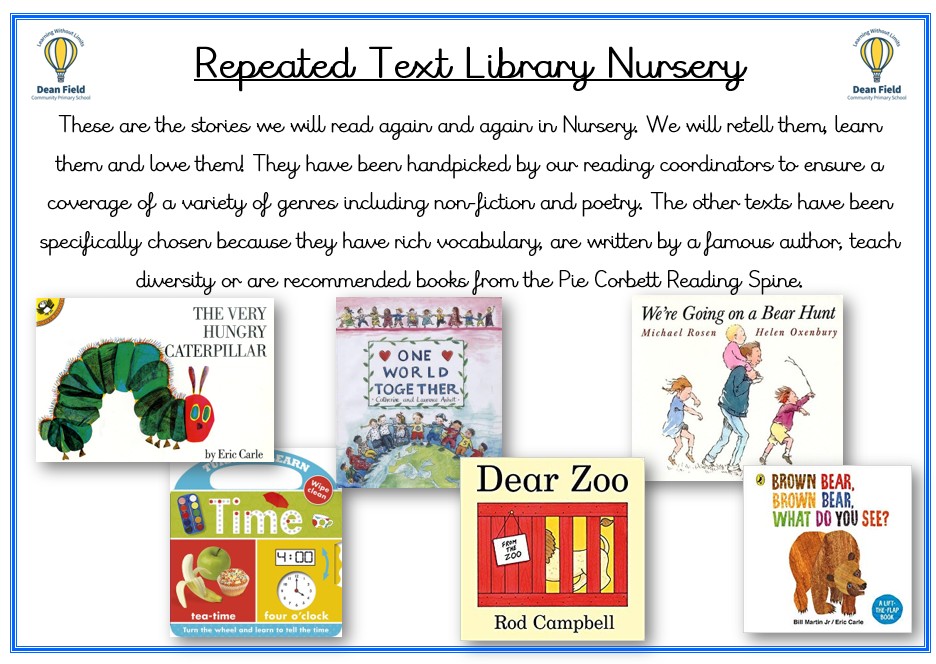
Stories play a central role in Nursery life. Children enjoy stories through role-play, imagination, videos and high-quality adult-led reading. These experiences develop listening skills, vocabulary, understanding and a love of books. This lays important foundations for the literacy learning that continues in Reception.
Daily Early Talk Boost sessions further support children’s communication, vocabulary, sentence structure and confidence in speaking. While designed to support children with delayed language, this programme benefits all learners and helps ensure strong communication skills are in place for future learning.
WellComm is also used to screen and support children’s speech, language and communication development. It helps staff identify children’s strengths and any areas where additional support may be needed, ensuring early intervention and targeted strategies are put in place. This supports all children to develop secure communication skills, building strong foundations for learning in Nursery, Reception and beyond.
Concept Cat is delivered through a dedicated weekly session to support children’s understanding of key early concepts such as size, position, colour, time and feelings. Learning is explored through stories, discussion and play-based activities, helping children develop the language they need to make sense of the world around them. Each week, learning from Concept Cat is shared with parents, supporting consistency between home and school and strengthening children’s communication and understanding.
Early Maths
Children develop early mathematical understanding through White Rose Maths, which is planned and delivered through our continuous provision. Carefully sequenced learning opportunities are embedded within play-based activities, allowing children to explore number, pattern, shape and measure in meaningful and engaging ways. This is supported by Ten Town, which focuses on one number at a time to build secure number sense. Learning is practical, visual and hands-on, and every child is provided with a Ten Town home login so learning can continue beyond the classroom.
Physical Development and Early Writing
In line with the Writing Framework 2025, children develop early writing skills through a strong focus on physical development and mark-making, recognising that writing emerges from movement, play and talk. Children take part in daily activities that strengthen both gross and fine motor skills, which are essential foundations for early writing.
Activities such as Squiggle Whilst You Wiggle support large body movements linked to mark-making and the exploration of early letter-like shapes, while Dough Disco develops fine motor control and finger strength through playful, engaging exercises. These multisensory experiences help children build confidence, control and enjoyment in mark-making, ensuring they are physically ready for writing as they move into Reception without placing inappropriate pressure on formal outcomes.
Health, Independence and Self-Care
Children take part in a daily toothbrushing programme, using their own named toothbrush to promote good oral hygiene and develop independence. Snack times, including fruit and milk, are used as meaningful opportunities to build confidence, independence and positive social skills, supporting children’s overall wellbeing and readiness to learn.

Outdoor Learning
Our outdoor environment is a stimulating extension of the Nursery classroom, carefully planned to incorporate all seven areas of the EYFS curriculum. Children have daily opportunities to develop gross motor skills, explore the natural environment, engage in imaginative and creative play and build early foundations in maths and communication. Outdoor learning supports children to grow in confidence and independence, take safe and supported risks and develop physical strength through active play.
Indoor Learning
Our Nursery classroom is thoughtfully organised into clear learning zones each designed to support the seven areas of the EYFS curriculum. This purposeful layout ensures children have access to a wide range of play-based experiences that promote curiosity, independence and a love of learning.
The indoor environment encourages choice and exploration allowing children to move freely between areas, follow their interests and take increasing ownership of their learning. This approach supports the development of self-motivation, problem-solving, creativity and resilience ensuring all children are supported to engage deeply and make progress across all areas of development.
Nursery Learning Areas (Progressive Towards Reception)
- Literacy Area
This zone is a calm, welcoming space designed to develop a love of books and early communication skills. Our Reading Garden provides a cosy environment where children can enjoy books independently or share stories with adults. Children explore familiar texts from our Repeated Text Library, story sacks and simple prompts to develop early comprehension, vocabulary and storytelling skills. Opportunities for mark-making and early writing are embedded through playful experiences, helping children begin to see themselves as confident communicators and preparing them for the more structured reading and writing activities in Reception.
- Mathematics Area
This area is equipped with counting resources, pattern blocks, measuring tools and practical problem-solving activities. Linked to White Rose Maths, children explore early number, shape, pattern and measure through hands-on play. By manipulating concrete resources, children begin to develop mathematical language, reasoning and understanding, laying secure foundations for the more focused mathematical learning they will encounter in Reception.
- Role-Play / Small World Area
Imaginative role-play and small world environments support the development of Communication and Language, PSED and creative thinking. Children use stories, real-life experiences and their imagination to explore different roles and scenarios. Through play, they practise turn-taking, negotiation and empathy, developing social and emotional skills that will support more complex collaborative play and storytelling in Reception.
- Creative Arts Area
This creative space offers opportunities for painting, collage, construction and model-making, supporting Expressive Arts and Design. Children are encouraged to experiment with materials, explore textures and express ideas freely. These experiences develop fine motor skills, imagination and confidence while encouraging discussion and shared creativity, preparing children for more purposeful design and creative tasks in Reception.
- Construction and Engineering Area
Children access a range of building resources including blocks, magnetic shapes and construction kits. Both large and small-scale building supports problem-solving, spatial awareness and teamwork. Children begin to explore early engineering concepts such as balance, stability and cause-and-effect, building the skills needed for more complex construction challenges in Reception.
- Sensory / Investigation Area
This area encourages exploration and discovery through sand, water, natural materials and simple investigations. Children observe, experiment and ask questions, supporting Understanding the World and early scientific thinking. Sensory play also strengthens fine motor control, concentration and curiosity, forming a strong foundation for Reception investigations and enquiry-based learning.
- Writing and Handwriting Area
Alongside literacy, this area promotes early mark-making and pre-writing skills. Children have access to a variety of tools including crayons, chalk, felt tips and dry-wipe pens organised in clearly labelled containers to promote independence. Visual prompts such as name cards, picture cues and early phonics letter formation support children as they experiment with marks, symbols and early writing in a relaxed and playful way, preparing them for more structured handwriting practice in Reception.
Specialist Lessons in Nursery (Progressing to Reception)
French
Nursery children take part in weekly French sessions where they are introduced to basic vocabulary such as greetings, colours and numbers through songs, games and repetition. These playful experiences develop listening skills and confidence with language preparing children for continued language learning in Reception.
Music and Movement
Weekly music and movement sessions help children develop body awareness, coordination and confidence. Activities include ring games, action songs, Cosmic Yoga and movement inspired by animals and stories. Children explore rhythm, speed and volume through stretching, clapping, stamping and using props such as scarves. These sessions support gross motor development, listening skills, self-expression and social interaction, forming a foundation for more structured music and PE lessons in Reception.
Reception (Clear Progression From Nursery)
Reception builds directly on Nursery experiences by offering greater structure, independence and challenge while maintaining a play-based, engaging approach. Learning areas remain familiar but expectations increase, with more focus on sustained attention, early transcription, problem-solving and collaboration. Specialist lessons expand to include computing, executive function skills, structured PE, PSHE through Jigsaw, and music aligned with KS1 progression, ensuring children are fully prepared for Year 1.Preparing for Reception and Beyond
Preparing for Reception and Beyond
We prepare children carefully for the transition into Reception by placing strong emphasis on developing the foundational skills needed for the next stage of learning including communication and language, early reading, early writing, maths and independence. Alongside these skills, we support children to develop confidence, resilience, self-regulation and positive relationships ensuring they are emotionally ready for the expectations of Reception.
Nursery children regularly join Reception pupils for shared experiences such as outdoor play and whole-school activities: including singing assemblies. As children approach the end of Nursery, staff plan purposeful transition activities and share assessment information with the Reception team. This ensures children feel familiar, secure and confident and that learning in Reception builds directly on each child’s strengths and next steps.
How to Join
Our Nursery is open to all children from the age of 3 until they reach statutory school age. Government-funded hours can be used and sessions are flexible.
To arrange a visit, find out more or enquire about joining, please contact the school office on 01422 258258 or email [email protected].